In fact, forget for a moment about the actual testing for safety and efficacy. Suppose someone proposing one of these social engineering
experiments (a.k.a. “legislation”) had to get his proposal past and ethics
panel, just as researchers conducting experiments on animals and humans need to do. “Suspected or likely side effects of your proposal include involuntary job loss,
reduction of total productivity…benefits are highly speculative. I’m sorry, it would
simply be unconscionable to test this ‘medicine’ on unwilling subjects. Denied.” I could understand someone arguing that we just gotta have pollution control, or we just gotta have military defense. Having no policy at all regarding these problems may be just as unethical as having some slightly misguided policy, so there's no moral trump card with which to simply halt all government activity. But most of what the government does is some kind of sinister social engineering, attempting to steer us toward someone's vision of a great society and away from the paths we would choose for ourselves. There are entire categories of government meddling and regulation that don't need to exist at all, most of which almost certainly wouldn't pass the hypothetical ethics panel.
Thursday, December 26, 2019
FDA Approval Process For Government Programs
I’m trying to imagine what it would be like if government
policy had to pass and FDA-like bureaucracy, being tested for “efficacy and
safety.” Please demonstrate to the satisfaction of the panel that a tweak to
the minimum wage (or *any* minimum wage, or any restriction at all on labor
contracts for that matter), or a new regulation or subsidy on health care, or a
change to entitlement programs, will be “effective” in the sense of achieving
its intended benefits and “safe” in the sense of having acceptable costs and side-effects.
This would be a much smaller government, one that is much more constrained to
doing *only* those things that are legitimate functions of government. Some of these policies are *literally*
medicine. Health care policy is explicitly aimed at improving health measures
in some way. In this upside-down world, this kind of medicine is shoved down
your throat against your will *without* any kind of vetting procedure, while
you are forbidden from taking medicine (pharmaceuticals and other chemical
substances) that you actually want to take unless it passes muster with the
FDA. This is backwards. The standard for medicine that we’re compelled to take
against our will should be higher, not lower.

When Does Pharmacology "Cause" Behavior?
When is it meaningful to speak of the pharmacology of a drug causing a person's behavior? I think that this concept has been overdone, particularly with respect to the "opioid epidemic" narrative.
Start with the easy cases, where we can definitely attribute the response to a drug to its pharmacology. Some drugs clearly reduce a person's capacity, mental and physical. Alcohol slows your reaction time and can even make you fall asleep at the wheel. Opioids can likewise make someone drowsy or unresponsive. Obviously they are used as general anesthetics for surgery. A dose much lower than that used in surgery can have a milder but still noticeable effect. Someone in such a state of diminished capacity might be prone to accidents, but I don't want to call this a "behavior." A drunk driver and a sober driver are both trying to get to their destination safely, it's just that the drunk is much worse at it. The ability of certain drugs to incapacitate their users is "pure pharmacology". That's not what I want to discuss here. I'm trying to get to behaviors, deliberate actions, that are in some sense caused by drugs.
Sometimes people who drink alcohol are more likely to get into fights or behave violently toward family members. The same is true of people who use certain stimulants. Someone in a very excitable state may be on a hair-trigger and might throw a punch in a situation that their sober self would handle more calmly. I think it makes sense to label this kind of thing "pharmacologically induced violence." It's not mere diminished capacity as described in the above paragraph. It's not that the drunk was reaching for his beer, stumbled, and plowed his knuckles into someone's cheek. Starting a fight is different from stumbling on the sidewalk or crashing your car. It's a behavior. There is an underlying intent. It's a choice, and the drunk is simply worse at making choices than his sober self.
There are certain drugs that can drive people into extremely excitable states. Synthetic cannabis (sometimes called Spice or K2) can sometimes make users extremely irrational. A paramedic friend of mine once described to me an episode in which he had to handle such a person, who was clearly out of his mind. This kid smoked too much Spice and was kicking and flailing at the first responders who were trying to help him. Some psychoactive substances, which are sold in head shops as "bath salts", have a similar reputation for driving people insane. PCP has a mostly unearned reputation for causing similar outbursts; Jacob Sullum corrects the record on PCP in his book Saying Yes. Some of these stories are overblown or apocryphal. The man who famously ate someone's face off was not high on bath salts, even though it was initially reported that he was. (Why is it that the initial report is always 100 times louder than the retraction?) People occasionally do shocking, crazy things, and for whatever reason "He must have been on drugs" always seems like a plausible explanation. Sometimes first responders or medical personnel make incautious statements to the media before actually double-checking the likely causes of someone's outburst, and media outlets dutifully repeat the message to a receptive public. The public loves a good drug-panic story, whether it happens to be true or not. Exaggerated or not, there are certainly cases where drug-induced psychosis is the best explanation for someone's shocking behavior. It makes sense to talk about the pharmacology of the drugs causing someone to have an irrational outburst (shouting obscenities are random passers-by, starting a fight, etc.). The drug can legitimately be considered the cause of the behavior in a but-for sense.
What about opioid addiction and overdose? More to the point, what about legitimate medical prescriptions leading to an opioid addiction? Here I think it's an incorrect framing to posit the drugs as the cause of the behavior. It is true that if someone is on opioids for an extended period of time, they will probably develop a physical dependence on opioids. They will have developed some degree of tolerance, and they will experience withdrawal symptoms when they stop taking them. The physical symptoms can be quite unpleasant. But physical dependence is quite distinct from addiction. Physical dependence is not a behavior. It will not by itself cause a person to seek opioids on the black market. Someone who takes a long-term course of opioids and is then tapered off by his doctor will not be driven to addiction if he follows the doctor's directions. Addiction is what happens when someone deliberately and repeatedly deviates from "use as directed." It makes little sense to speak of prescriptions "turning patients into addicts". Even if we posit that some people get a mildly pleasant buzz from taking their pills regularly, it's just not the case that this pleasure causes them to escalate their dose or to continue to seek opioids after their prescription runs out. There is nothing inherent to the pharmacology of the opioids that causes these behaviors. Indeed, the vast majority of opioids users don't have any kind of problem going off them when their course ends. Some sloppy writers and commentators have tried to cast this as a cosmic game of dice or Russian Roulette in which patients are subjected to a random risk, as if every ten thousandth pill contained the "addiction virus." It's much more useful to think of addiction as a series of deliberate behaviors that eventually become hard to control.
(I once heard Doctor Jeff Singer, someone who I correspond with occasionally, describe a patient's hesitation about opioids. The patient's concern went something like, "I want to be careful about this, because last time I was prescribed opioids I got addicted and experienced nasty withdrawal symptoms." Jeff explained that the patient was emphatically not an addict. He had experienced physical dependence, but not addiction. In fact the patient was quite deliberately avoiding these substances because he'd had such an adverse reaction to the withdrawal. Addiction, by contrast, is the compulsive, continued use of a substance despite the harm its causing you. I thought this was a nice illustration of the difference between addiction and physical dependence.)
Let's grant that physical dependence can be so extreme and the withdrawal symptoms so severe in some opioid patients that continued use is irresistible. Such a person continues to use after their prescription is gone, purchasing pills or even heroin on the black market. It's a stretch to say that the pharmacology of opioids led to their addiction. As difficult as withdrawal is, continued use is a very deliberately chosen path. But forget that for a moment. Let's grant for the sake of argument that this is an instance of pharmacologically induced behavior. It might make sense to blame their use of black market pills or even heroin on the body's physiological response to an opioid prescription. Certainly the continued use of opioids leads to nasty withdrawal symptoms, and opioids purchased on the black market relieve those symptoms. But take a closer look at what's actually killing these people. "Drug overdose" is a misnomer, a short-hand term that misstates the true cause of death. The CDC actually refers to these deaths as "drug poisonings." The term "overdose" seems to imply that the decedent took too large a dose of a single substance, but that's the exception rather than the rule. Most drug-related deaths are multi-drug poisonings. See where I've written about this previously, here and here and here for example. Let's dispel this notion of a hapless addict popping pill after pill until he just keels over. This just doesn't match the reality. It isn't the case that it's just "so good" that the addict needs another and another until he's taken too much. A much more likely scenario is that someone is taking opioids with benzodiazepines (~1/3 of prescription opioid related deaths involve this combination) or alcohol (~14%) or cocaine (~12%). Maybe some of the benzo plus opioid poisonings are accidental mixtures of medications, but it appears that many opioid users take benzos because it potentiates the high. Presumably many or most of them know it's dangerous but they do it anyway. Even granting the premise that the pharmacology of prescription opioids causes continued opioid use, it's far from clear that it should cause the patient to mix medications or start using cocaine. It just makes a lot more sense to model this behavior as deliberate thrill-seeking than as "I lost a game of pharmacological roulette and it turned me into an addict."
I think it's worth taking a serious look at the risks of prescribing opioids for pain, acute or chronic. Some people are fast or slow metabolizers, depending on whether they have zero, one, or two copies of a certain gene. Some of these people really are effectively playing a game of pharmacological roulette, as in they might have a fatal reaction to a dose that's benign for an average person. And we certainly want to warn people about withdrawal symptoms so they can make an informed decision. Even granting all that, any talk about the "risk of addiction" is badly missing the mark.
By the way, if there is a "risk of addiction" that roughly corresponds to the ratio of addicts to opioid prescriptions, apparently that risk has been coming down on a per-prescription or per-patient basis. Rates of opioid misuse and addiction have been basically flat or even falling over a time period when prescriptions were skyrocketing. This makes little sense if you think that there is some disembodied probability, the "risk of addiction", faced by all opioid patients. But it makes perfect sense if we think there's a more or less fixed population of extreme risk-takers, and they happen to be using whatever drugs are most available. In this light, I find it just atrocious that state governments are going after Purdue and other opioid manufacturers. We need to purge this notion that addiction is something that is done to you, that passively happens to you as you dutifully take your meds. People don't simply sleep-walk into addiction when taking their medication as directed, and there is nothing inherent in the drugs pharmacology that makes them deviate from "use as directed." We need to debunk this absurd idea that smooth, sophisticated pharmaceutical firms just had their way with us, even getting past the doctors who stood as gate-keepers.
I hope it's clear that this isn't mere hair splitting about what to name something. There are some very important implications, political, moral, and legal. If the pharmaceutical companies aren't culpable (as I think they are not), then they shouldn't be sued for selling opioids. They should be able to continue selling to their very willing buyers, some of whom commit suicide when they are involuntarily tapered. If the addicts are deliberately engaging in risky behaviors, we should not be restricting opioid prescriptions for their sake. Restrictions make it harder for desperate pain patients to acquire opioids. It seems to me that the moral weight of a single pain sufferer who is involuntarily cut off from opioids ought to outweigh the voluntarily undertaken self-harm of many dozens or even hundreds of addicts. Tens of millions of Americans suffer from chronic pain at any given moment (I've seen estimates as high as 1 in 3 that will eventually suffer from it), compared to less than one percent of the population being addicted to pain pills (having a "use disorder within the past year" anyway). It would be hard to make this calculus work out in favor of restricting access. Even supposing some utilitarian calculation gave the nod to further restricting opioid prescriptions, most of us are not amoral utilitarians. People rightly apply a fairness standard to public policy. "You can't have opioids, because, while I'm quite sure you won't have any problems, there is some small chance that Jonny over there will steal them from you and abuse them." This seems terribly unfair. It makes sense to worry about who is harmed or helped and to give consideration to whether that harm is self-imposed or not.
If this narrative of pharmaceutical companies involuntarily converting normal patients into addicts is wrong (and I insist it is), then basically all the policy responses and "public service announcements" by our institutions of public health have been deeply misguided. Sure, some individuals have impulse control problems. But we're not zombies. We're not programmable robots who can simply be re-programmed to serve big corporations' earnings goals. Habit-forming drugs don't sink "chemical hooks" into our brains and control us against our will. There is an element of free choice in all of this that is quite separate from the drugs' pharmacological effects.
___________________
Something I haven't touched on in this post is the fact that most opioid addicts don't even get their start with a prescription, an observation that should relieve opioid manufacturers of any culpability. The idea that I'm arguing against in this post, the notion that drugs take over people's minds and make them do things they don't want to do, is sometimes called "voodoo pharmacology." There is apparently some powerful voodoo going on here. Apparently the pharmaceutical companies are hijacking the brains not of their legitimate patients, but of other people in society who acquire opioids illicitly. Manufacturers, distributors, and patients are by and large acting responsibly, but highly motivated addicts are stealing left-over pills from unfinished prescriptions (a peculiar phenomenon, by the way, for a drug that is supposedly so irresistible). It might make some sense to hold the patient culpable for inadequately securing their leftover pills, but to follow this back up to the manufacturers? This is an absurd concept of legal liability, one which I don't believe anyone has even tried to defend.
Start with the easy cases, where we can definitely attribute the response to a drug to its pharmacology. Some drugs clearly reduce a person's capacity, mental and physical. Alcohol slows your reaction time and can even make you fall asleep at the wheel. Opioids can likewise make someone drowsy or unresponsive. Obviously they are used as general anesthetics for surgery. A dose much lower than that used in surgery can have a milder but still noticeable effect. Someone in such a state of diminished capacity might be prone to accidents, but I don't want to call this a "behavior." A drunk driver and a sober driver are both trying to get to their destination safely, it's just that the drunk is much worse at it. The ability of certain drugs to incapacitate their users is "pure pharmacology". That's not what I want to discuss here. I'm trying to get to behaviors, deliberate actions, that are in some sense caused by drugs.
Sometimes people who drink alcohol are more likely to get into fights or behave violently toward family members. The same is true of people who use certain stimulants. Someone in a very excitable state may be on a hair-trigger and might throw a punch in a situation that their sober self would handle more calmly. I think it makes sense to label this kind of thing "pharmacologically induced violence." It's not mere diminished capacity as described in the above paragraph. It's not that the drunk was reaching for his beer, stumbled, and plowed his knuckles into someone's cheek. Starting a fight is different from stumbling on the sidewalk or crashing your car. It's a behavior. There is an underlying intent. It's a choice, and the drunk is simply worse at making choices than his sober self.
There are certain drugs that can drive people into extremely excitable states. Synthetic cannabis (sometimes called Spice or K2) can sometimes make users extremely irrational. A paramedic friend of mine once described to me an episode in which he had to handle such a person, who was clearly out of his mind. This kid smoked too much Spice and was kicking and flailing at the first responders who were trying to help him. Some psychoactive substances, which are sold in head shops as "bath salts", have a similar reputation for driving people insane. PCP has a mostly unearned reputation for causing similar outbursts; Jacob Sullum corrects the record on PCP in his book Saying Yes. Some of these stories are overblown or apocryphal. The man who famously ate someone's face off was not high on bath salts, even though it was initially reported that he was. (Why is it that the initial report is always 100 times louder than the retraction?) People occasionally do shocking, crazy things, and for whatever reason "He must have been on drugs" always seems like a plausible explanation. Sometimes first responders or medical personnel make incautious statements to the media before actually double-checking the likely causes of someone's outburst, and media outlets dutifully repeat the message to a receptive public. The public loves a good drug-panic story, whether it happens to be true or not. Exaggerated or not, there are certainly cases where drug-induced psychosis is the best explanation for someone's shocking behavior. It makes sense to talk about the pharmacology of the drugs causing someone to have an irrational outburst (shouting obscenities are random passers-by, starting a fight, etc.). The drug can legitimately be considered the cause of the behavior in a but-for sense.
What about opioid addiction and overdose? More to the point, what about legitimate medical prescriptions leading to an opioid addiction? Here I think it's an incorrect framing to posit the drugs as the cause of the behavior. It is true that if someone is on opioids for an extended period of time, they will probably develop a physical dependence on opioids. They will have developed some degree of tolerance, and they will experience withdrawal symptoms when they stop taking them. The physical symptoms can be quite unpleasant. But physical dependence is quite distinct from addiction. Physical dependence is not a behavior. It will not by itself cause a person to seek opioids on the black market. Someone who takes a long-term course of opioids and is then tapered off by his doctor will not be driven to addiction if he follows the doctor's directions. Addiction is what happens when someone deliberately and repeatedly deviates from "use as directed." It makes little sense to speak of prescriptions "turning patients into addicts". Even if we posit that some people get a mildly pleasant buzz from taking their pills regularly, it's just not the case that this pleasure causes them to escalate their dose or to continue to seek opioids after their prescription runs out. There is nothing inherent to the pharmacology of the opioids that causes these behaviors. Indeed, the vast majority of opioids users don't have any kind of problem going off them when their course ends. Some sloppy writers and commentators have tried to cast this as a cosmic game of dice or Russian Roulette in which patients are subjected to a random risk, as if every ten thousandth pill contained the "addiction virus." It's much more useful to think of addiction as a series of deliberate behaviors that eventually become hard to control.
(I once heard Doctor Jeff Singer, someone who I correspond with occasionally, describe a patient's hesitation about opioids. The patient's concern went something like, "I want to be careful about this, because last time I was prescribed opioids I got addicted and experienced nasty withdrawal symptoms." Jeff explained that the patient was emphatically not an addict. He had experienced physical dependence, but not addiction. In fact the patient was quite deliberately avoiding these substances because he'd had such an adverse reaction to the withdrawal. Addiction, by contrast, is the compulsive, continued use of a substance despite the harm its causing you. I thought this was a nice illustration of the difference between addiction and physical dependence.)
Let's grant that physical dependence can be so extreme and the withdrawal symptoms so severe in some opioid patients that continued use is irresistible. Such a person continues to use after their prescription is gone, purchasing pills or even heroin on the black market. It's a stretch to say that the pharmacology of opioids led to their addiction. As difficult as withdrawal is, continued use is a very deliberately chosen path. But forget that for a moment. Let's grant for the sake of argument that this is an instance of pharmacologically induced behavior. It might make sense to blame their use of black market pills or even heroin on the body's physiological response to an opioid prescription. Certainly the continued use of opioids leads to nasty withdrawal symptoms, and opioids purchased on the black market relieve those symptoms. But take a closer look at what's actually killing these people. "Drug overdose" is a misnomer, a short-hand term that misstates the true cause of death. The CDC actually refers to these deaths as "drug poisonings." The term "overdose" seems to imply that the decedent took too large a dose of a single substance, but that's the exception rather than the rule. Most drug-related deaths are multi-drug poisonings. See where I've written about this previously, here and here and here for example. Let's dispel this notion of a hapless addict popping pill after pill until he just keels over. This just doesn't match the reality. It isn't the case that it's just "so good" that the addict needs another and another until he's taken too much. A much more likely scenario is that someone is taking opioids with benzodiazepines (~1/3 of prescription opioid related deaths involve this combination) or alcohol (~14%) or cocaine (~12%). Maybe some of the benzo plus opioid poisonings are accidental mixtures of medications, but it appears that many opioid users take benzos because it potentiates the high. Presumably many or most of them know it's dangerous but they do it anyway. Even granting the premise that the pharmacology of prescription opioids causes continued opioid use, it's far from clear that it should cause the patient to mix medications or start using cocaine. It just makes a lot more sense to model this behavior as deliberate thrill-seeking than as "I lost a game of pharmacological roulette and it turned me into an addict."
I think it's worth taking a serious look at the risks of prescribing opioids for pain, acute or chronic. Some people are fast or slow metabolizers, depending on whether they have zero, one, or two copies of a certain gene. Some of these people really are effectively playing a game of pharmacological roulette, as in they might have a fatal reaction to a dose that's benign for an average person. And we certainly want to warn people about withdrawal symptoms so they can make an informed decision. Even granting all that, any talk about the "risk of addiction" is badly missing the mark.
By the way, if there is a "risk of addiction" that roughly corresponds to the ratio of addicts to opioid prescriptions, apparently that risk has been coming down on a per-prescription or per-patient basis. Rates of opioid misuse and addiction have been basically flat or even falling over a time period when prescriptions were skyrocketing. This makes little sense if you think that there is some disembodied probability, the "risk of addiction", faced by all opioid patients. But it makes perfect sense if we think there's a more or less fixed population of extreme risk-takers, and they happen to be using whatever drugs are most available. In this light, I find it just atrocious that state governments are going after Purdue and other opioid manufacturers. We need to purge this notion that addiction is something that is done to you, that passively happens to you as you dutifully take your meds. People don't simply sleep-walk into addiction when taking their medication as directed, and there is nothing inherent in the drugs pharmacology that makes them deviate from "use as directed." We need to debunk this absurd idea that smooth, sophisticated pharmaceutical firms just had their way with us, even getting past the doctors who stood as gate-keepers.
I hope it's clear that this isn't mere hair splitting about what to name something. There are some very important implications, political, moral, and legal. If the pharmaceutical companies aren't culpable (as I think they are not), then they shouldn't be sued for selling opioids. They should be able to continue selling to their very willing buyers, some of whom commit suicide when they are involuntarily tapered. If the addicts are deliberately engaging in risky behaviors, we should not be restricting opioid prescriptions for their sake. Restrictions make it harder for desperate pain patients to acquire opioids. It seems to me that the moral weight of a single pain sufferer who is involuntarily cut off from opioids ought to outweigh the voluntarily undertaken self-harm of many dozens or even hundreds of addicts. Tens of millions of Americans suffer from chronic pain at any given moment (I've seen estimates as high as 1 in 3 that will eventually suffer from it), compared to less than one percent of the population being addicted to pain pills (having a "use disorder within the past year" anyway). It would be hard to make this calculus work out in favor of restricting access. Even supposing some utilitarian calculation gave the nod to further restricting opioid prescriptions, most of us are not amoral utilitarians. People rightly apply a fairness standard to public policy. "You can't have opioids, because, while I'm quite sure you won't have any problems, there is some small chance that Jonny over there will steal them from you and abuse them." This seems terribly unfair. It makes sense to worry about who is harmed or helped and to give consideration to whether that harm is self-imposed or not.
If this narrative of pharmaceutical companies involuntarily converting normal patients into addicts is wrong (and I insist it is), then basically all the policy responses and "public service announcements" by our institutions of public health have been deeply misguided. Sure, some individuals have impulse control problems. But we're not zombies. We're not programmable robots who can simply be re-programmed to serve big corporations' earnings goals. Habit-forming drugs don't sink "chemical hooks" into our brains and control us against our will. There is an element of free choice in all of this that is quite separate from the drugs' pharmacological effects.
___________________
Something I haven't touched on in this post is the fact that most opioid addicts don't even get their start with a prescription, an observation that should relieve opioid manufacturers of any culpability. The idea that I'm arguing against in this post, the notion that drugs take over people's minds and make them do things they don't want to do, is sometimes called "voodoo pharmacology." There is apparently some powerful voodoo going on here. Apparently the pharmaceutical companies are hijacking the brains not of their legitimate patients, but of other people in society who acquire opioids illicitly. Manufacturers, distributors, and patients are by and large acting responsibly, but highly motivated addicts are stealing left-over pills from unfinished prescriptions (a peculiar phenomenon, by the way, for a drug that is supposedly so irresistible). It might make some sense to hold the patient culpable for inadequately securing their leftover pills, but to follow this back up to the manufacturers? This is an absurd concept of legal liability, one which I don't believe anyone has even tried to defend.
Wednesday, December 18, 2019
Why No New Cities? Why Not Move Tech Hubs?
There are two books I've read fairly recently that complement each other well: Hive Mind: How Your Nation's IQ Matters So Much More Than Your Own by Garett Jones and Shut Out: How a Housing Shortage Caused the Great Recession and Crippled Our Economy by Kevin Erdmann. I think some enterprising academic could do a useful synthesis of the concepts contained in these books.
Hive Mind is, roughly speaking, about how IQ affects productivity, and in particular how this is more important for collectives than for individuals. Your nation's IQ is a stronger predictor of national GDP than your individual IQ is of your particular earnings/productivity. There is a discussion of the "O-ring" theory of economic development, an idea for which one of the 2019 Nobel recipients, Michael Kremer, was famous. The idea here is that you need a lot of really smart people working on a particular project, because any weak link is a possible point of failure. The "O-ring" part is a reference to the Challenger space shuttle explosion, in which a single point of failure, literally an o-ring, caused a massive engineering project to fail and killed several people in the process. New technologies are susceptible to many points of failure, so you need a lot of very highly skilled people working on them. You can't just hire two really good software engineers and then a bunch of B-level engineers to do the rest of the work. Nor can you hire ten mediocre software engineers and simply merge their output to be the same as that of one good engineer. If you're building something new and innovative, you need a bunch of top 1% people on your team. Skimping on talent introduces more points of failure, and these accumulate quickly. The chance of failure grows exponentially with the number of points of potential failure, so reducing the probability that any one point will fail is enormously valuable. This theory probably explains why all the really smart programmers go to Silicon Valley to work with other really smart programmers. It explains why some big cities are world hubs for particular industries rather than having the work be dispersed throughout the nation or the world. It could also explain why there might be a large quality gap between the very best and the second best product on the market. If all the top-tier people are working for the industry leader, the second-tier companies are trying to cobble together the same product out of second-tier talent. They produce something of value, but perhaps it's a distant second. (I'm thinking iPod vs. Zune, or the iPhone vs. its early competitors. Possibly Facebook vs. other social media or Google vs. other search engines, but these could be network effects rather than examples of quality differences.) I can't find it now, but I remember reading about the candidate cities for Amazon's upcoming new campus a few years ago. Chicago was briefly a candidate, but someone commented that the limiting factor was talent. Chicago, it seems, has a lot of "top 10%" people but not quite so many "top 1%" people. My midwestern blood initially boiled at the elitist comment, but I calmed down and recognized the point. Couldn't they have just hired more people at the 90th and 95th percentile and used whatever top 1% talent they could find? Apparently not. They were looking for very high concentrations of extremely skilled workers. Whoever was making that decision was engaging in some kind of "o-ring technology" thinking.
Shut Out is about dysfunctional housing markets in major population centers. Supply restrictions (mostly out-of-control zoning laws) in cities like San Francisco, Los Angeles, New York, and Boston lead to extremely high housing prices. Note that these cities are major centers of industry: tech in San Francisco, finance in New York, biotech in Boston. Erdmann's story is that, contra the dominant narrative, there was never a "housing bubble." Rather there was never enough housing in these major population centers. The price of housing rose so high in these "closed access" cities that they caused demand to increase in nearby regions. These nearby regions weren't as restrictive as closed access cities, but nevertheless failed to keep up with skyrocketing demand. Erdmann dubs these "contagion cities." In other words, supply restrictions in major hubs for highly skilled workers were so bad they caused knock-on effects in the rest of the nation. The standard narrative is that uncontrolled speculation drove up the price of housing until it eventually got completely unmoored from the fundamentals, until housing prices eventually crashed. That's kind of hard to swallow when you look at the growth trajectory of total housing. The "supply restrictions" story is a better explanation of the skyrocketing prices than the "artificially inflated demand" story.
What's the connection between these two books? Shut Out had me wondering, why doesn't someone just start a new city? Or start a tech hub in an open access city, where housing can grow without obnoxious restrictions? I think one would have to lean very strongly on a Hive Mind type of argument to explain this lack of new cities or new industry hubs. It kind of makes sense that a data scientist in Silicon Valley would not simply quit his job and go work for a company in Omaha, Nebraska. This person's skills might make him useful to just one employer in a city that isn't a tech- or finance-hub, but might present many more options in Silicon Valley. If the job in Omaha doesn't work out, the cost of job-switching is much higher. Maybe this isn't such a big deal to any one person. There may be many such people who are willing to move to a slightly more boring city with fewer colleagues of a similar skill level. But it definitely creates a friction. The city with the fewest frictions will likely attract a hugely disproportionate fraction of the top data scientists, because people aren't just evaluating cities in isolation. There are network effects. The city that first starts to attract lots of talented data scientists will tend to attract more talented data scientists. That first city is a focal point, and it's hard to simply designate some other low-cost city as a new focal point. Something has gone terribly wrong here in the sense that the major centers of productivity also have the worst zoning laws and nimby-ism. Parasitic local governments probably understand that their city's status as a hub is unlikely to change, so they don't have to worry too much about providing good government. They can indulge the locals' nimby-ism and economic populism to the hilt without much changing their tax base. Some kind of concerted effort, given enough political will, could conceivably fix their local housing market. But why bother?
___________________________________
Scott Alexander recently wrote a post about billionaire philanthropy. In a post that is generally positive on philanthropy, he writes disparagingly that "...the George Kaiser Family Foundation has decided the best use of its $4.4 billion is to pay techies $10,000 each to move to Tulsa, Oklahoma." If they actually pulled this off and managed to create a second tech hub in the midwest, the benefits to society could be in the many billions of dollars. If it takes a few billion dollars to incentivize the initial movement to a new hub, that could be well worth it. Admittedly it's hard to understand the value of the George Kaiser Family Foundation's initiative in isolation, but it makes a lot more sense in light of Shut Out and Hive Mind.
Hive Mind is, roughly speaking, about how IQ affects productivity, and in particular how this is more important for collectives than for individuals. Your nation's IQ is a stronger predictor of national GDP than your individual IQ is of your particular earnings/productivity. There is a discussion of the "O-ring" theory of economic development, an idea for which one of the 2019 Nobel recipients, Michael Kremer, was famous. The idea here is that you need a lot of really smart people working on a particular project, because any weak link is a possible point of failure. The "O-ring" part is a reference to the Challenger space shuttle explosion, in which a single point of failure, literally an o-ring, caused a massive engineering project to fail and killed several people in the process. New technologies are susceptible to many points of failure, so you need a lot of very highly skilled people working on them. You can't just hire two really good software engineers and then a bunch of B-level engineers to do the rest of the work. Nor can you hire ten mediocre software engineers and simply merge their output to be the same as that of one good engineer. If you're building something new and innovative, you need a bunch of top 1% people on your team. Skimping on talent introduces more points of failure, and these accumulate quickly. The chance of failure grows exponentially with the number of points of potential failure, so reducing the probability that any one point will fail is enormously valuable. This theory probably explains why all the really smart programmers go to Silicon Valley to work with other really smart programmers. It explains why some big cities are world hubs for particular industries rather than having the work be dispersed throughout the nation or the world. It could also explain why there might be a large quality gap between the very best and the second best product on the market. If all the top-tier people are working for the industry leader, the second-tier companies are trying to cobble together the same product out of second-tier talent. They produce something of value, but perhaps it's a distant second. (I'm thinking iPod vs. Zune, or the iPhone vs. its early competitors. Possibly Facebook vs. other social media or Google vs. other search engines, but these could be network effects rather than examples of quality differences.) I can't find it now, but I remember reading about the candidate cities for Amazon's upcoming new campus a few years ago. Chicago was briefly a candidate, but someone commented that the limiting factor was talent. Chicago, it seems, has a lot of "top 10%" people but not quite so many "top 1%" people. My midwestern blood initially boiled at the elitist comment, but I calmed down and recognized the point. Couldn't they have just hired more people at the 90th and 95th percentile and used whatever top 1% talent they could find? Apparently not. They were looking for very high concentrations of extremely skilled workers. Whoever was making that decision was engaging in some kind of "o-ring technology" thinking.
Shut Out is about dysfunctional housing markets in major population centers. Supply restrictions (mostly out-of-control zoning laws) in cities like San Francisco, Los Angeles, New York, and Boston lead to extremely high housing prices. Note that these cities are major centers of industry: tech in San Francisco, finance in New York, biotech in Boston. Erdmann's story is that, contra the dominant narrative, there was never a "housing bubble." Rather there was never enough housing in these major population centers. The price of housing rose so high in these "closed access" cities that they caused demand to increase in nearby regions. These nearby regions weren't as restrictive as closed access cities, but nevertheless failed to keep up with skyrocketing demand. Erdmann dubs these "contagion cities." In other words, supply restrictions in major hubs for highly skilled workers were so bad they caused knock-on effects in the rest of the nation. The standard narrative is that uncontrolled speculation drove up the price of housing until it eventually got completely unmoored from the fundamentals, until housing prices eventually crashed. That's kind of hard to swallow when you look at the growth trajectory of total housing. The "supply restrictions" story is a better explanation of the skyrocketing prices than the "artificially inflated demand" story.
What's the connection between these two books? Shut Out had me wondering, why doesn't someone just start a new city? Or start a tech hub in an open access city, where housing can grow without obnoxious restrictions? I think one would have to lean very strongly on a Hive Mind type of argument to explain this lack of new cities or new industry hubs. It kind of makes sense that a data scientist in Silicon Valley would not simply quit his job and go work for a company in Omaha, Nebraska. This person's skills might make him useful to just one employer in a city that isn't a tech- or finance-hub, but might present many more options in Silicon Valley. If the job in Omaha doesn't work out, the cost of job-switching is much higher. Maybe this isn't such a big deal to any one person. There may be many such people who are willing to move to a slightly more boring city with fewer colleagues of a similar skill level. But it definitely creates a friction. The city with the fewest frictions will likely attract a hugely disproportionate fraction of the top data scientists, because people aren't just evaluating cities in isolation. There are network effects. The city that first starts to attract lots of talented data scientists will tend to attract more talented data scientists. That first city is a focal point, and it's hard to simply designate some other low-cost city as a new focal point. Something has gone terribly wrong here in the sense that the major centers of productivity also have the worst zoning laws and nimby-ism. Parasitic local governments probably understand that their city's status as a hub is unlikely to change, so they don't have to worry too much about providing good government. They can indulge the locals' nimby-ism and economic populism to the hilt without much changing their tax base. Some kind of concerted effort, given enough political will, could conceivably fix their local housing market. But why bother?
___________________________________
Scott Alexander recently wrote a post about billionaire philanthropy. In a post that is generally positive on philanthropy, he writes disparagingly that "...the George Kaiser Family Foundation has decided the best use of its $4.4 billion is to pay techies $10,000 each to move to Tulsa, Oklahoma." If they actually pulled this off and managed to create a second tech hub in the midwest, the benefits to society could be in the many billions of dollars. If it takes a few billion dollars to incentivize the initial movement to a new hub, that could be well worth it. Admittedly it's hard to understand the value of the George Kaiser Family Foundation's initiative in isolation, but it makes a lot more sense in light of Shut Out and Hive Mind.
Monday, December 9, 2019
My Problem Employee
I wrote this all down over a year ago, and it's been sitting in my list of drafts since then. The situation has resolved itself, and this is no longer my problem. Re-reading it now, parts of it seem whiny and I considered just trashing it. But I thought someone else who has had to manage an incompetent employee might commiserate. This was a deep source of frustration in my life for a year and a half, and I was looking for something written by someone dealing with the same challenge. I'll share in case someone in a similar position finds this useful.
I also tie this to Bryan Caplan's book The Case Against Education. In order to explain why education has such strong signaling value, he has to be able to explain why employers don't just hire indiscriminately and fire the poor performers. I wrote about that here. I have a much finer appreciation for Caplan's discussion of firing aversion. I also can appreciate why "employer learning" is so slow; this is the process by which employers figure out their employees' productivity. HR departments sometimes actively censor or purge this information.
Anyway, I'll start with the gossipy details about my under-performing employee.
____________________________________
I had a problem employee who was not competent at his job. I’d given him two major projects that he was supposed to work on semi-autonomously. The pace of the work was incredibly slow, and it often came back done incorrectly. It wasn't to my specifications, so I'd say so and ask for it again, sometimes pointing to the documentation where I specified what I wanted, such as a prior e-mail or project plan. I could have easily done both projects and had them done sooner and to my specifications when he wasn't even halfway done. I often had to reached into his project with a heavy hand, going so far as to give him working code that finished his job. He often declined to use what I’d given him, having failed to understand the code, and went back to tinkering with whatever half-completed code he was working on.
I also tie this to Bryan Caplan's book The Case Against Education. In order to explain why education has such strong signaling value, he has to be able to explain why employers don't just hire indiscriminately and fire the poor performers. I wrote about that here. I have a much finer appreciation for Caplan's discussion of firing aversion. I also can appreciate why "employer learning" is so slow; this is the process by which employers figure out their employees' productivity. HR departments sometimes actively censor or purge this information.
Anyway, I'll start with the gossipy details about my under-performing employee.
____________________________________
I had a problem employee who was not competent at his job. I’d given him two major projects that he was supposed to work on semi-autonomously. The pace of the work was incredibly slow, and it often came back done incorrectly. It wasn't to my specifications, so I'd say so and ask for it again, sometimes pointing to the documentation where I specified what I wanted, such as a prior e-mail or project plan. I could have easily done both projects and had them done sooner and to my specifications when he wasn't even halfway done. I often had to reached into his project with a heavy hand, going so far as to give him working code that finished his job. He often declined to use what I’d given him, having failed to understand the code, and went back to tinkering with whatever half-completed code he was working on.
A huge part of the problem was lack of communication on his part. I would discuss his projects with him in person, but my critiques and suggestions for different directions did not make it into his work product. I confirmed fairly late in the game that my comments were utterly failing to register with him. He basically came out and admitted this was true. He just would not open up and say “I’m confused about what you want. Explain it to me again.” Or “I don’t understand how this discussion affects my projects. Can you clarify?” We have regular group
meetings in which I will discuss topics and code strategies directly relevant
to his work. I would point out the relevance to his project, then follow up in
an e-mail pointing out the relevance and even pointing him to the relevant
lines of already-well-commented-code. Despite basically handing him the answer on a silver platter,
this stuff still would not make it into his work product, and his work would
come back wrong (also late).
All this came to a
head when he “confronted” me about my management style. I had been sending him
almost-daily e-mails asking him to correct his work. I would ask why stuff had
been missed. Was he just being forgetful? Was he deciding to do something
differently from what I specified? I needed to know so I could fix the problem.
He was declining to answer such questions, because he obviously didn’t care for them. (Another related long-standing pattern: he declines to volunteer any information, even
relevant information, like “I’m confused and need more direction.” He declined
to answer a pretty direct question in front of my boss in a meeting until
pressed multiple times. It was embarrassing. I pointed it out to my boss after the meeting and
said this was a pattern.)
He tried to blame the issues on me, which I thought crossed a
line. He said that the sheer volume of "details" being thrown at him was too much
for one man. (It was not; there was so much spoon-feeding and repetition that
it should have been easy for him.) It was apparently unrealistic of me to expect that all
of those details would be remembered or make their way into his work product.
One of my recommendations that had set him off was to write down better notes and organize them. He had a habit of not taking any notes at all. I think his philosophy must have been "If it's important it'll come up again" or "If it's important, I'll remember it." If his problem is his own poor memory, better note-taking is the obvious solution. I
have a pretty damned good memory, but I still miss things. I take notes when my boss or my boss's boss are commenting on my work product. So does every other productive employee. It's basic office-work hygiene. He’d balked at this
and other suggestions, suggesting that my style was too controlling and
saying that no other manager had ever exerted this level of control over his
work. According to him, he’d never had bosses send back so much of his work for corrections. (I now have private knowledge that this isn’t true, having discussed him with a previous manager who'd had the same frustrations.) He even told me a cute story from when he had, in the
past, managed a fast food place. When he tried to crack down on his staff and
enforce certain standards, many of them promptly quit on him. I tried very
careful just to let him talk without interrupting. Why stop a man when he’s offering to hang himself
like that? But sarcastic comments presented themselves. (“This isn’t a Burger
King.” Or “I really liked the end of your story, where the bad employees all
quit. I wonder if that solved their problem.” Of course I did not say any of these
things.) The message was loud and clear. His poor performance was not his fault, it was mine. It
was a result of my being too demanding and attentive to detail. He also said
repeatedly that he’d never had performance issues with other managers, which I
knew wasn’t true. I wasn’t about to tell him that I knew what previous managers had said about his work, but it was useful to know how poorly his self-assessment was calibrated to reality.
After letting him go on for a while, I said that letting up
on attention to detail was not an option for me, and that, yes, he would have
to fix his problem of dropping instructions. Taking notes would help. Once
again, he balked at this suggestion. (Gee, if only there were some way to
augment my fallible human memory. Alas, there isn’t!) But more fundamentally
he didn’t understand the technical and theoretical details of the tasks he’s
doing. So instructions, even when they are pretty clear, failed to register with
him. What he perceived as “a bunch of details” were actually crucial things that
can make his work product unusable if not implemented correctly. Missing them
revealed a basic lack of understanding. He was un-self-critical, apparently incapable of doing a mea culpa. He couldn’t simply admit error and try to fix his problems.
I did some questioning after this meeting, and it turns out
the problem employee had persistent performance issues with pretty much every
manager he'd worked for. He’d been passed around at this company for something like ten years,
from one manager to the next. I don’t know why my boss accepted him on the team,
or why it was up to me to say this guy is incompetent and needs to go. Maybe it’s
because this is the first time he’s worked for someone who is more technically
competent and “down in the weeds” than he is. I can reach into his work, spot
his math or coding errors, point out conceptual errors, get his work started
for him, etc. I’m about the least confrontational guy around, but I finally had
enough. It was taking so much time to correct his work and document his poor
performance. Plus it was hugely stressful. I was having trouble sleeping at
night, sometimes for days, dreading having to have another unpleasant conversation.
All this had me thinking about Bryan Caplan’s review of the “firing
aversion” literature. In The Case Against Education, Caplan has a long discussion of why college degrees affect your pay for such a long time. Couldn't employers simply hire indiscriminately (less discriminantly, anyway), then keep the good performers and fire the bad ones? Couldn't they spot employees whose credentials overstate their productivity and demote or fire them? And shouldn't this make credentialing pretty useless? It turns out there is a literature on this topic, called "employer learning." It actually takes quite a long time for employers to figure out how productive their employees really are. Like, years or decades, not weeks or months. People can "fake it" for a while, or put in extra effort and look more productive temporarily when the boss is getting suspicious. Besides, even when there's no doubt about someone's poor productivity (as is the case with my problem employee), managers are often reluctant to fire out of sympathy. (In my particular case, my sympathy had run out long before the problem was resolved.)
Even when managers are willing to fire, Human Resource departments are often hard blocks on doing the obvious thing. "Do you have documentation? Oh, you do! But, sorry, you didn't document it through our HR system, so it doesn't count. Let's put the problem employee on a 'performance improvement plan.'" From HR's perspective, a termination is a potential lawsuit. They want to do everything they can to make the problem employees quit of their own volition. They also want to make sure it's not just a problem of an incompetent manager making a bad call or failing to manage the problem on their own turf. This is very frustrating to deal with. Putting someone on a performance improvement plan is a pretty direct way of saying, "You aren't qualified for your job." You have to do this, then face that person day in and day out, and this humiliating HR ritual is hanging over both of your heads every time you converse with your employee. In his book, Caplan says something about how even slackers can temporarily look busy and conscientious when under temporary scrutiny. ("Look busy! The boss is watching!") Problematic employees "graduate" from the performance improvement plan, and from HR's perspective the problem is solved and the slate is clean. In reality, the underlying problem is still lurking under the surface and likely to reemerge. And managers are reluctant to go through this emotionally draining process.
Following HR's process is especially tricky for a job like mine. We aren't making widgets here. Employee competence are things like "Does the employee understand the statistical concepts necessary to do the work?" Or "Was the statistical analysis done to the outlined specifications?" Sometimes mistakes creep in to statistics work that are hard to define ahead of time as a "not-do." You're just supposed to know that something looks odd, using your judgement, and locate and fix the problem. It would be easy if I could simply say, "Produce X widgets per week or you're not qualified." In an environment where productivity is hard (impossible really) to measure and even harder to define ahead of time, it's very difficult to implement HR's performance improvement plan. And I don't relish the idea of constantly being questioned, "How am I doing? Do I make the cut?"
_________________________
Some people seem to believe businesses have absolute mastery over their employees and engage in cut-throat employment practices. If this were the case, there wouldn't be so much hesitation over canning poor performers. Caplan's story holds up pretty well. Businesses are often paralyzed by the fear of wrongful termination suits or poor morale that result from performance-based firings. Firings and layoffs still happen, it's just that companies are sometimes too hesitant to do the obvious thing. A combination of human psychology (bad performance evaluations are very unpleasant on both sides of the conversation) and bad HR policy creates a lot of friction. People really do get locked into roles they aren't qualified for, sometimes for a decade or more.
Even when managers are willing to fire, Human Resource departments are often hard blocks on doing the obvious thing. "Do you have documentation? Oh, you do! But, sorry, you didn't document it through our HR system, so it doesn't count. Let's put the problem employee on a 'performance improvement plan.'" From HR's perspective, a termination is a potential lawsuit. They want to do everything they can to make the problem employees quit of their own volition. They also want to make sure it's not just a problem of an incompetent manager making a bad call or failing to manage the problem on their own turf. This is very frustrating to deal with. Putting someone on a performance improvement plan is a pretty direct way of saying, "You aren't qualified for your job." You have to do this, then face that person day in and day out, and this humiliating HR ritual is hanging over both of your heads every time you converse with your employee. In his book, Caplan says something about how even slackers can temporarily look busy and conscientious when under temporary scrutiny. ("Look busy! The boss is watching!") Problematic employees "graduate" from the performance improvement plan, and from HR's perspective the problem is solved and the slate is clean. In reality, the underlying problem is still lurking under the surface and likely to reemerge. And managers are reluctant to go through this emotionally draining process.
Following HR's process is especially tricky for a job like mine. We aren't making widgets here. Employee competence are things like "Does the employee understand the statistical concepts necessary to do the work?" Or "Was the statistical analysis done to the outlined specifications?" Sometimes mistakes creep in to statistics work that are hard to define ahead of time as a "not-do." You're just supposed to know that something looks odd, using your judgement, and locate and fix the problem. It would be easy if I could simply say, "Produce X widgets per week or you're not qualified." In an environment where productivity is hard (impossible really) to measure and even harder to define ahead of time, it's very difficult to implement HR's performance improvement plan. And I don't relish the idea of constantly being questioned, "How am I doing? Do I make the cut?"
_________________________
Some people seem to believe businesses have absolute mastery over their employees and engage in cut-throat employment practices. If this were the case, there wouldn't be so much hesitation over canning poor performers. Caplan's story holds up pretty well. Businesses are often paralyzed by the fear of wrongful termination suits or poor morale that result from performance-based firings. Firings and layoffs still happen, it's just that companies are sometimes too hesitant to do the obvious thing. A combination of human psychology (bad performance evaluations are very unpleasant on both sides of the conversation) and bad HR policy creates a lot of friction. People really do get locked into roles they aren't qualified for, sometimes for a decade or more.
“Do you think *horrible topic* is funny?!?”
Normal Person: (Tells joke about horrible topic X.)
Normal Person: Okay, but then I saw you cheer and celebrate on social media when someone actually died. On multiple occasions. Some people are actively making the argument that it's okay to use violence against their political opponents, and others are actively engaging in such violence. But, yeah, let's pretend my thing was "dangerous". Let's say I'm the "offensive" one here.
_______________________
Sorry if I'm literally straw-manning the Obnoxious Scold here. Obviously I'm giving Normal Person a lot more space to state his ideas. I couldn't think of a better way to structure this post. I am getting increasingly annoyed with people who understand how humor works but pretend not to. It is positively perverse that the scolds are going after professional comedians and their stand-up material. Comedians are supposed to point out uncomfortable truths (or "truths", because comedians say a lot of shit that's funny but not really true). Their job is to prod at our sacred taboos. We laugh because we are acknowledging that the thought is taboo and that the joke is inappropriate in polite society. Someone who says "There's nothing funny about X!" is failing to understand how humor works. Most humor isn't about something pleasant and wonderful happening.
Obnoxious Scold: Wait! Do you think X is funny?!?
Normal Person: What?! No, of course not. X isn’t funny. X is
deadly serious...
Obnoxious Scold: Okay. I guess that’s good.
Normal Person: …which is why jokes about X are hilarious!
Obnoxious Scold: Alright, now. I see what you did. Not cool.
Normal Person: It's not like everyone
thinks X is a wonderful and happy subject. That's not why jokes about X are funny. The ensuing laughter doesn’t stem
from our enjoyment of X actually happening. Jokes about X work because we all
share a mutual understanding that X is deadly serious. The joke violates sacred
norms. It reminds us of temptations that we resist or thoughts that we banish from our minds as taboo. So we laugh when Emo Philips pushes a man off a bridge over a minor
disagreement over religious doctrine. Or when a parent jokes about eating their child for dinner or
flushing him down the toilet. Or when a song from a saucy puppet show reminds us that "Everyone's a little bit racist." The joke is a surprising reminder that the veneer of civilization is thin,
that something horrible and taboo is lurking just under the surface, that we’re
not totally innocent. The different reactions to jokes about X and X itself are
like the difference between being prodded in our sensitive parts by a
professional torturer and being tickled in the ribs by a trusted love one. It's the difference between being razzed by your best friend and being insulted in public by a rival about your very real shortcomings. It would be awful if I actually committed infanticide and then cannibalism, or if I actually cuckolded or sexually dominated my best friend. Far worse than if my joke about X had been a serious suggestion. Tickling and teasing are harmless for exactly the same reason that crude jokes are harmless. There is enough trust between the tickler and the tickled, the teaser and the teased, the joke teller and the listener, to know that it's not serious. Actually, you fucking well know all this already, so why am I bothering? I have heard you make "lighthearted" comments about wanting to murder someone. You can drop the whole "outrage as a performance piece" act, because I literally saw you joking about physically assaulting or murdering your political opponents.
Obnoxious Scold: That really was just a joke. Everyone understands that people are joking about wanting to murder or assault annoying people. On the thing you were joking about, some people actually think that's okay.Normal Person: Okay, but then I saw you cheer and celebrate on social media when someone actually died. On multiple occasions. Some people are actively making the argument that it's okay to use violence against their political opponents, and others are actively engaging in such violence. But, yeah, let's pretend my thing was "dangerous". Let's say I'm the "offensive" one here.
_______________________
Sorry if I'm literally straw-manning the Obnoxious Scold here. Obviously I'm giving Normal Person a lot more space to state his ideas. I couldn't think of a better way to structure this post. I am getting increasingly annoyed with people who understand how humor works but pretend not to. It is positively perverse that the scolds are going after professional comedians and their stand-up material. Comedians are supposed to point out uncomfortable truths (or "truths", because comedians say a lot of shit that's funny but not really true). Their job is to prod at our sacred taboos. We laugh because we are acknowledging that the thought is taboo and that the joke is inappropriate in polite society. Someone who says "There's nothing funny about X!" is failing to understand how humor works. Most humor isn't about something pleasant and wonderful happening.
Wednesday, November 27, 2019
Cannabis Legalization Doesn't Drive Up Violence
Many states have begun to legalize recreational marijuana. Some people, most notably Alex Berenson, have claimed that this is leading to deteriorating trends in certain vital statistics post legalization. He points to the apparent increases in violent crime in Colorado, Oregon, and Washington. I first became aware of this earlier this year, when Berenson published a piece in the New York Times warning about the supposed dangers of marijuana. Malcolm Gladwell and Tyler Cowen amplified the signal, in my opinion far too credulously. It's come to my attention again. Berenson's recent debate with Jacob Sullum (my write-up of that discussion here) led me to do some digging. To get a good idea of Berenson's position, it's worth listening to this Joe Rogan podcast, in which Joe hosts a sort of discussion/debate between Berenson and Dr. Michael Hart. It's a good source to understand the nature of Berenson's claim. His take is that marijuana use causes psychosis in some people; I think he admits that only a small fraction of people are really at risk and most normal people don't have anything to worry about. Nevertheless, in his telling, increasing the incidence of cannabis use will cause some small fraction of people to turn psychotic. Psychosis is an enormous risk factor in the commission of violence; he mentions a 20x figure in the Joe Rogan podcast, as in people with psychosis are 20 times as likely to commit violent crime. So more cannabis -> more psychosis -> more violent crime.
So how does one decide whether cannabis legalization increases violent crime? The naive first approach would be to look at rates of violent crime before and after legalization. If violence increases post legalization, that's at least suggestive. But of course that doesn't tell you anything about causation. Violence crime rates increase and decrease for lots of reasons. If violent crime is increasing in states that legalize, we need a control group to compare them to. We need to establish the counterfactual, as in what would have happened if not for cannabis legalization. Also, as with anything we measure, there is random noise in these statistics. That's not to say we don't know how many murders actually happened in Colorado in a given year. Even supposing we count those accurately and to a body (and I think the counts are quite precise), the process that generates those body counts is random. Many of these violent crimes are crimes of passion. Someone gets angry in the moment and assaults or murders someone; the same person on a slightly better day wouldn't have become a murderer. Someone fires a gun with the intent to kill, but misses their victim. A murderer experiences a delay in their plans when their victim does something unexpected, giving the would-be murderer time to rethink things. So the actual realized crime rate, literally the count of crimes divided by the population, is a somewhat noisy measure of the thing we're really interested in, the underlying propensity of the population to commit violent crime. So we need error bars. We need confidence intervals to tell us if an X% increase in crime rates is something that could come about by random chance or something that indicates that the underlying drivers of crime have actually changed.
There have been some very good studies that find appropriate control groups and compute the confidence intervals, and I'll get to these later. There seems to be some contention about whether those controls are done appropriately. Perhaps the statisticians, who are often accused of being themselves biased in favor of legalizing cannabis, are using statistical magic to make a real effect disappear. No doubt this is a very real problem in some academic disciplines. There are generally many different model specifications to choose from. Just a few nobs to turn and flips to switch on your regression analysis leads to a combinatorial explosion of possible models. It's always possible that the modeler has done a large number of these and cherry-picked the one that gave him the desired result. I think the appropriate way to deal with this is for the statisticians and critics to come together and discuss the various choices in model design, decide which specifications are more plausible or appropriate, settle on a constrained space of model specs, and openly report the sensitivity of the results to various specs.
For the moment, I'll start with crude methods.
Below I have plots of violent crime rates by state for the states that have legalized cannabis. The data all comes from here. (Simply click on Summary (SRS) Data With Estimates and download the estimated_crimes.csv file. That's what I'm using to build these plots.) There are four kinds of violent crime tracked here: aggravated assault, homicide, rape, and robbery. If Berenson's story is correct, we're probably only interested in aggravated assault and homicide. It's unlikely that paranoid psychosis-induced violence would have an effect on the other categories of violence.
Start with aggravated assault, which is more frequent than murder and thus has a stronger signal, statistically speaking. Notice that I'm color-coding based on the year that cannabis was legalized. Colorado and Washington legalized in 2012. Oregon, Alaska, and DC legalized in 2014. California, Nevada, Massachusettes, and Maine legalized in 2016, and Vermont legalized in 2018. The data is only through 2018, so we only get one post-legalization data point for Vermont. (If the figure is overlapping the stuff on my side-bar, note that you can click directly on the figure to enlarge it for a clearer view.)

It's certainly true that some of these states have seen increases in violence, as measured by this statistic. The post-legalization trends for AK, CO, WA, and OR are up. But DC is down. CA, MA, ME, and NV are down, despite the trend for the nation as a whole (marked "US") being slightly up. California has been declining for two decades, despite having medical marijuana since 1996. Many think that medical legalization in California was de facto legalization, as it was permissible for a doctor to recommend it for almost anything. (I don't fully understand this, but doctors in California could issue "recommendations" that weren't officially "prescriptions", but as long as you secured such a recommendation you could get cannabis from a dispensary.) Other states placed tight constraints on what conditions were acceptable for medical cannabis, so the connection between medical cannabis and rates of recreational use is less clear. Note that Colorado and Washington initially decrease before coming back up. This is not a unambiguous "legalization leads to violence" story. Now let's look at homicide rates.
 Again, not an unambiguous story. Homicide certainly increased in Oregon, but then in 2018 it came back down to where it was 15 years ago. California is declining? DC is essentially flat. Certainly, Colorado, Alaska, and Washington look like they're up, but it would take some cherry-picking to tell an anti-legalization story.
Let's take a longer view. In the above, I'm purposefully focusing on the year 2000 and later so we can compare post-legalization to recent trends. What if we go all the way back to 1979, where the data begins? Violence was famously much higher in the 80s and 90s. As Stephen Pinker documents in his book Better Angels of Our Nature, violence has been declining for a very long time. Take a look at the recent trends in light of a historical perspective. Here is assault:

And here is homicide.

Other than assault in Alaska, the historical perspective makes the recent trends look puny. Don't get me wrong, it would be horrible if a state's violence rate went back to what it was in the 80s and 90s. I don't want be accused of making the argument: "The effect gets smaller when I rescale my y-axis." But we should try to appreciate the effect of cannabis on crime, whatever its magnitude, in context with other drivers of crime and other policy considerations. It is widely believed that drug prohibition is a major driver of violent crime because of black market violence, and the so-called "crack epidemic" of the 80s and 90s saw high levels violence between rival drug gangs. This was mostly not pharmacologically induced violence. This paper by Jeff Miron suggests that variation in the level drug enforcement explains something like half the variation in the murder rate. Note that's a regression analysis, and statements such as "explains half the variance" are statements about correlation, not causation. But the "causal" story is reinforced by the work of Paul Goldstien, who actually looked at all the murders in New York city from 1984 to1988. He coded them as non-drug related, pharmacologically induced violence, economic crimes to support a drug habit, and black market violence. Violence related to drug commerce was the dominant category. (See the discussion in the Miron paper, which also lists the Goldstein papers in the References.) If that's even close to correct, we should be far more concerned about violence related to drug trafficking than the pharmacologically induced violence that Berenson is warning us about.
Maybe actual use rates post legalization changed more in some states versus others? We don't care about legalization per se unless it drives up cannabis use and leads to these social problems that the critics are worried about. I looked this up, too. It's not exactly well organized, but SAMHSA tracks this by state and publishes reports. They have "past year" and "past month" marijuana use. I'm using past month, because presumably the higher-frequency use is what's going to track with excessive use and thus violence, assuming that causal connection exists. (Here is one year's data. I could not find a file where this was all in one place for all years. Also, some years have this in a pdf, while others had it in an Excel spreadsheet. I had to awkwardly key values from a pdf into my own spreadsheet for those years. Government agencies need to get a lot better about how they disseminate their data!) The SAMHSA reports compute by-state use rates using two years at a time, so, for example, 2016 on my charts is really 2016-2017. I couldn't find anything in the 2004-2008 time period, but one report had the data for "2002-2003". So we at least have one data point from the period well before legalization. Here is what I saw.
 Note that cannabis use trends upward even prior to legalization, but it definitely looks like there is a post-legalization increase. Unfortunately, there just aren't enough post-legalization data points for the states that legalized in 2014 and 2016 (and none yet for VT, which legalized in 2018). Now, one could seize on this and say, "Ah ha! Cannabis use increased more in Colorado, Oregon, and Washington, and those are the states with the clearest pattern of post-legalization increases in violence!" But it also looks like DC and Nevada saw a stark increase in cannabis use, and these jurisdictions bucked the "increasing violence" trend. California saw increasing rates of cannabis use for a decade and a half, but its rates of violent crime were declining over this period. Crudely speaking, this is a period of declining rates of violence and increasing rates of cannabis use.
For comparison, here are some non-legalizing states. It looks like cannabis use rates are increasing in many states that did not legalize. So the increase in the general trend for the US is not simply being driven by legalizing states.
 Maybe "past month use" isn't what we care about? Maybe it's only excessive, daily use that leads to psychosis and violence, and if we had that measure it would track with the violence rates? Maybe, but I would at least expect "past month use" and "daily use" to be highly correlated.
Of course, this is all very crude. Eyeballing graphs and computing raw statistics is dangerous. One is likely to fool oneself and spot patterns that aren't really there. We need a more rigorous analysis that controls for confounders and computes confidence intervals. I'm only showing this because some anti-pot crusaders obsess over the raw data. The statisticians who do a more rigorous analysis are sometimes accused of being biased, using statistical tricks to make the effect disappear. With the above plots, I'm merely trying to show that crude methods, like eyeballing the raw trends, don't tell an unambiguous "more cannabis -> more crime" story.
I found two good papers on the cannabis-violence question, both of which use synthetic controls. The idea here is that you find a set of "control" states that behaved like the "treatment" state prior to legalization. Actually, if I'm reading this right, the approach uses a weighted average of all "untreated" states, picking a set of weights that best matches the legalizing state's trends prior to legalization. (One paper uses a subset of non-legalizing states, which it calls "donor states".) Having established these weights, one can compute what the trend for the legalizing state should have been if it hadn't legalized, then compare that to what actually happened. One of these papers discusses legalization of medical cannabis, the other recreational legalization.
The paper on medical cannabis is called Joint Culpability: the Effect of Medical Marijuana Laws on Crime. Here is a link to the full paper. Medical marijuana laws are not the same as laws that fully legalize recreational marijuana, but surely they increase the availability of marijuana. Some states had lax prescribing guidelines, such that you could get a prescription for almost condition. In fact, anti-cannabis fuddy-duddies like to complain that medical cannabis was just a wedge issue designed to make recreational cannabis more acceptable. As described above, many of them complained that California's medical cannabis law was de facto legalization, considering the ease with which one could obtain a doctor's recommendation. Supposing these cannabis critics are correct, legalizing medical marijuana should have led to an increase in recreational use. It seems likely that there would be some leakage from legitimate prescriptions to recreational users. (Based on some personal anecdotes, I know that this happens to some extent.) This paper cites several studies that quantified the effect of medical marijuana on overall use; they suggest the increase is in the 10%-20% range. If our hypothesis is that an increase in recreational marijuana use leads to more violence, the experience of medical cannabis states is a useful test.
Generally the paper finds no statistically significant effect one way or the other on violent crime or property crime. But if one fixates specifically on California, there does appear to be a significant reduction (a ~20% reduction) in both types of crime. I'm happy to call California an outlier and just declare this a null result. But the result is not favorable to the "cannabis use causes violence" story. See the comparison of synthetic controls versus actual experience in California.
 The second paper is a student thesis by one Paul Lalonde titled Reeform Madness: Crime in the Changing Landscape of Marijuana Regulation. (I love the puns built into the titles!) It limits its analysis to Colorado and Washington. That makes sense. The crime data it uses is through 2016, so that doesn't give it much time to test the states that legalized in 2014 and 2016. It would be interesting to see this analysis redone in the next couple of years when more states have had a longer experience with full legalization.
By the way, if anyone is tempted to dismiss this as "some kid's term paper", note that Ben Hansen, got a similar result. Hansen is an academic economist with publications in the "synthetic controls" literature, notably this one, a working paper about the effects of cannabis legalization on auto fatalities. As far as I can tell he hasn't published on the violence question.
Reeform Madness generally finds that post-legalization violence rates in Colorado and Washington are slightly lower than the synthetic controls, and property crimes are slightly higher, but the results are not statistically significant. (Read the paper for the exact methodology; they're using some test statistics I'm not familiar with. Anyway, it's clear that they're not hitting the traditional "p < 0.05" threshold.)


In sum, while it's true that Colorado and Washington saw increases in violent crime post legalization, states that look like Colorado and Washington saw comparable increases. I'm quite happy to call this a null result or declare it inconclusive. But certainly this doesn't paint a picture of a post-legalization spike in violence, even for those states that definitely did see increases in murder and assault.
So how does one decide whether cannabis legalization increases violent crime? The naive first approach would be to look at rates of violent crime before and after legalization. If violence increases post legalization, that's at least suggestive. But of course that doesn't tell you anything about causation. Violence crime rates increase and decrease for lots of reasons. If violent crime is increasing in states that legalize, we need a control group to compare them to. We need to establish the counterfactual, as in what would have happened if not for cannabis legalization. Also, as with anything we measure, there is random noise in these statistics. That's not to say we don't know how many murders actually happened in Colorado in a given year. Even supposing we count those accurately and to a body (and I think the counts are quite precise), the process that generates those body counts is random. Many of these violent crimes are crimes of passion. Someone gets angry in the moment and assaults or murders someone; the same person on a slightly better day wouldn't have become a murderer. Someone fires a gun with the intent to kill, but misses their victim. A murderer experiences a delay in their plans when their victim does something unexpected, giving the would-be murderer time to rethink things. So the actual realized crime rate, literally the count of crimes divided by the population, is a somewhat noisy measure of the thing we're really interested in, the underlying propensity of the population to commit violent crime. So we need error bars. We need confidence intervals to tell us if an X% increase in crime rates is something that could come about by random chance or something that indicates that the underlying drivers of crime have actually changed.
There have been some very good studies that find appropriate control groups and compute the confidence intervals, and I'll get to these later. There seems to be some contention about whether those controls are done appropriately. Perhaps the statisticians, who are often accused of being themselves biased in favor of legalizing cannabis, are using statistical magic to make a real effect disappear. No doubt this is a very real problem in some academic disciplines. There are generally many different model specifications to choose from. Just a few nobs to turn and flips to switch on your regression analysis leads to a combinatorial explosion of possible models. It's always possible that the modeler has done a large number of these and cherry-picked the one that gave him the desired result. I think the appropriate way to deal with this is for the statisticians and critics to come together and discuss the various choices in model design, decide which specifications are more plausible or appropriate, settle on a constrained space of model specs, and openly report the sensitivity of the results to various specs.
For the moment, I'll start with crude methods.
The Raw Data
Below I have plots of violent crime rates by state for the states that have legalized cannabis. The data all comes from here. (Simply click on Summary (SRS) Data With Estimates and download the estimated_crimes.csv file. That's what I'm using to build these plots.) There are four kinds of violent crime tracked here: aggravated assault, homicide, rape, and robbery. If Berenson's story is correct, we're probably only interested in aggravated assault and homicide. It's unlikely that paranoid psychosis-induced violence would have an effect on the other categories of violence.
Start with aggravated assault, which is more frequent than murder and thus has a stronger signal, statistically speaking. Notice that I'm color-coding based on the year that cannabis was legalized. Colorado and Washington legalized in 2012. Oregon, Alaska, and DC legalized in 2014. California, Nevada, Massachusettes, and Maine legalized in 2016, and Vermont legalized in 2018. The data is only through 2018, so we only get one post-legalization data point for Vermont. (If the figure is overlapping the stuff on my side-bar, note that you can click directly on the figure to enlarge it for a clearer view.)

It's certainly true that some of these states have seen increases in violence, as measured by this statistic. The post-legalization trends for AK, CO, WA, and OR are up. But DC is down. CA, MA, ME, and NV are down, despite the trend for the nation as a whole (marked "US") being slightly up. California has been declining for two decades, despite having medical marijuana since 1996. Many think that medical legalization in California was de facto legalization, as it was permissible for a doctor to recommend it for almost anything. (I don't fully understand this, but doctors in California could issue "recommendations" that weren't officially "prescriptions", but as long as you secured such a recommendation you could get cannabis from a dispensary.) Other states placed tight constraints on what conditions were acceptable for medical cannabis, so the connection between medical cannabis and rates of recreational use is less clear. Note that Colorado and Washington initially decrease before coming back up. This is not a unambiguous "legalization leads to violence" story. Now let's look at homicide rates.

Let's take a longer view. In the above, I'm purposefully focusing on the year 2000 and later so we can compare post-legalization to recent trends. What if we go all the way back to 1979, where the data begins? Violence was famously much higher in the 80s and 90s. As Stephen Pinker documents in his book Better Angels of Our Nature, violence has been declining for a very long time. Take a look at the recent trends in light of a historical perspective. Here is assault:

And here is homicide.

Other than assault in Alaska, the historical perspective makes the recent trends look puny. Don't get me wrong, it would be horrible if a state's violence rate went back to what it was in the 80s and 90s. I don't want be accused of making the argument: "The effect gets smaller when I rescale my y-axis." But we should try to appreciate the effect of cannabis on crime, whatever its magnitude, in context with other drivers of crime and other policy considerations. It is widely believed that drug prohibition is a major driver of violent crime because of black market violence, and the so-called "crack epidemic" of the 80s and 90s saw high levels violence between rival drug gangs. This was mostly not pharmacologically induced violence. This paper by Jeff Miron suggests that variation in the level drug enforcement explains something like half the variation in the murder rate. Note that's a regression analysis, and statements such as "explains half the variance" are statements about correlation, not causation. But the "causal" story is reinforced by the work of Paul Goldstien, who actually looked at all the murders in New York city from 1984 to1988. He coded them as non-drug related, pharmacologically induced violence, economic crimes to support a drug habit, and black market violence. Violence related to drug commerce was the dominant category. (See the discussion in the Miron paper, which also lists the Goldstein papers in the References.) If that's even close to correct, we should be far more concerned about violence related to drug trafficking than the pharmacologically induced violence that Berenson is warning us about.
Maybe actual use rates post legalization changed more in some states versus others? We don't care about legalization per se unless it drives up cannabis use and leads to these social problems that the critics are worried about. I looked this up, too. It's not exactly well organized, but SAMHSA tracks this by state and publishes reports. They have "past year" and "past month" marijuana use. I'm using past month, because presumably the higher-frequency use is what's going to track with excessive use and thus violence, assuming that causal connection exists. (Here is one year's data. I could not find a file where this was all in one place for all years. Also, some years have this in a pdf, while others had it in an Excel spreadsheet. I had to awkwardly key values from a pdf into my own spreadsheet for those years. Government agencies need to get a lot better about how they disseminate their data!) The SAMHSA reports compute by-state use rates using two years at a time, so, for example, 2016 on my charts is really 2016-2017. I couldn't find anything in the 2004-2008 time period, but one report had the data for "2002-2003". So we at least have one data point from the period well before legalization. Here is what I saw.
 Note that cannabis use trends upward even prior to legalization, but it definitely looks like there is a post-legalization increase. Unfortunately, there just aren't enough post-legalization data points for the states that legalized in 2014 and 2016 (and none yet for VT, which legalized in 2018). Now, one could seize on this and say, "Ah ha! Cannabis use increased more in Colorado, Oregon, and Washington, and those are the states with the clearest pattern of post-legalization increases in violence!" But it also looks like DC and Nevada saw a stark increase in cannabis use, and these jurisdictions bucked the "increasing violence" trend. California saw increasing rates of cannabis use for a decade and a half, but its rates of violent crime were declining over this period. Crudely speaking, this is a period of declining rates of violence and increasing rates of cannabis use.
For comparison, here are some non-legalizing states. It looks like cannabis use rates are increasing in many states that did not legalize. So the increase in the general trend for the US is not simply being driven by legalizing states.

Of course, this is all very crude. Eyeballing graphs and computing raw statistics is dangerous. One is likely to fool oneself and spot patterns that aren't really there. We need a more rigorous analysis that controls for confounders and computes confidence intervals. I'm only showing this because some anti-pot crusaders obsess over the raw data. The statisticians who do a more rigorous analysis are sometimes accused of being biased, using statistical tricks to make the effect disappear. With the above plots, I'm merely trying to show that crude methods, like eyeballing the raw trends, don't tell an unambiguous "more cannabis -> more crime" story.
Studies Using Synthetic Controls
I found two good papers on the cannabis-violence question, both of which use synthetic controls. The idea here is that you find a set of "control" states that behaved like the "treatment" state prior to legalization. Actually, if I'm reading this right, the approach uses a weighted average of all "untreated" states, picking a set of weights that best matches the legalizing state's trends prior to legalization. (One paper uses a subset of non-legalizing states, which it calls "donor states".) Having established these weights, one can compute what the trend for the legalizing state should have been if it hadn't legalized, then compare that to what actually happened. One of these papers discusses legalization of medical cannabis, the other recreational legalization.
The paper on medical cannabis is called Joint Culpability: the Effect of Medical Marijuana Laws on Crime. Here is a link to the full paper. Medical marijuana laws are not the same as laws that fully legalize recreational marijuana, but surely they increase the availability of marijuana. Some states had lax prescribing guidelines, such that you could get a prescription for almost condition. In fact, anti-cannabis fuddy-duddies like to complain that medical cannabis was just a wedge issue designed to make recreational cannabis more acceptable. As described above, many of them complained that California's medical cannabis law was de facto legalization, considering the ease with which one could obtain a doctor's recommendation. Supposing these cannabis critics are correct, legalizing medical marijuana should have led to an increase in recreational use. It seems likely that there would be some leakage from legitimate prescriptions to recreational users. (Based on some personal anecdotes, I know that this happens to some extent.) This paper cites several studies that quantified the effect of medical marijuana on overall use; they suggest the increase is in the 10%-20% range. If our hypothesis is that an increase in recreational marijuana use leads to more violence, the experience of medical cannabis states is a useful test.
Generally the paper finds no statistically significant effect one way or the other on violent crime or property crime. But if one fixates specifically on California, there does appear to be a significant reduction (a ~20% reduction) in both types of crime. I'm happy to call California an outlier and just declare this a null result. But the result is not favorable to the "cannabis use causes violence" story. See the comparison of synthetic controls versus actual experience in California.

By the way, if anyone is tempted to dismiss this as "some kid's term paper", note that Ben Hansen, got a similar result. Hansen is an academic economist with publications in the "synthetic controls" literature, notably this one, a working paper about the effects of cannabis legalization on auto fatalities. As far as I can tell he hasn't published on the violence question.
Reeform Madness generally finds that post-legalization violence rates in Colorado and Washington are slightly lower than the synthetic controls, and property crimes are slightly higher, but the results are not statistically significant. (Read the paper for the exact methodology; they're using some test statistics I'm not familiar with. Anyway, it's clear that they're not hitting the traditional "p < 0.05" threshold.)
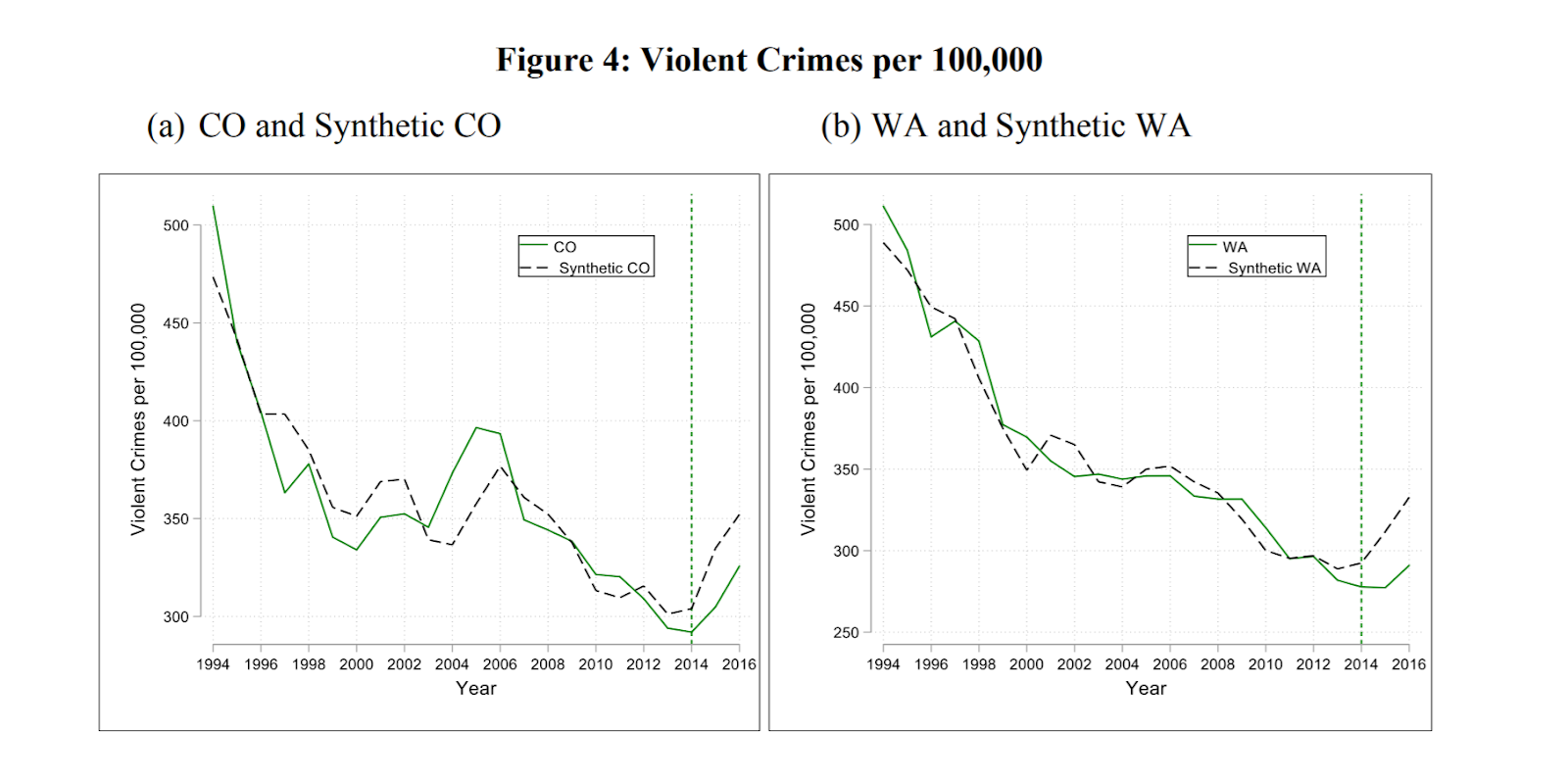


In sum, while it's true that Colorado and Washington saw increases in violent crime post legalization, states that look like Colorado and Washington saw comparable increases. I'm quite happy to call this a null result or declare it inconclusive. But certainly this doesn't paint a picture of a post-legalization spike in violence, even for those states that definitely did see increases in murder and assault.
Back-of-the-Envelope Sanity Check
I want to do a quick computation just to get an idea of what magnitude of effect Berenson is suggesting. Past-month cannabis use in Colorado was 10.4% of the population in 2011/2012 and 16.4% in 2016/2017. Let's subtract the two and say that 6% of the population turned from non-smokers to smokers because of legalization. The murder rate increased from 3.0 per 100k in 2011 to 3.4 per 100k in 2016, a 13% increase. For 6% of the population to drive a 13% increase in murder at the population level, this must mean that "past month cannabis use" is a huge risk factor for murder. It apparently increases your chance of becoming a murderer by 216% ( = 13% / 6% )! Even making some more conservative adjustments, this is a huge effect. Suppose that in addition to creating new users, legalization doubled the intensity of use among exiting users. So let's say effectively 16.4% of the population are "new users", adding the actual new users to the existing users who are now doing double-duty. And suppose we only blame pot legalization for half the increase in the murder rate (so call it 6.5% instead of 13%). We're still saying 16.4% of the population caused a 6.5% increase in the murder rate, so this population's murder rate must have increased by 40%. These seem like implausibly large figures to me. The people who are attributing even small population-level increased in violence to cannabis legalization are actually positing a huge effect of marijuana's propensity to cause violence. Of course, most of them will say, "No, no, you won't be 40% more likely to commit murder, or any more likely for that matter. It's all due to a small subset of people who can't handle it, have a bad reaction, and turn psychotic." But the smaller we make the "susceptible" population, the larger the effect on violence we must posit.
There is nothing special about Colorado; I get similar absurdly large "effect sizes" when I look at Oregon and Washington, depending on the end-points. Of course, as implied by the discussion above, doing this exercise for some states would yield negative effects of legalization on crime.
I think that you can probably find news stories about people who smoked way too much, got overly excited or paranoid, and did violence to someone. I even think it's reasonable to say that cannabis use was the cause, in a but for sense, of some of those violent acts. (I'm reminded of an old post at Slate Star Codex in which Scott Alexander describes a colleague's frustration with marijuana. It seems that cannabis use interfered badly with his treatment of some of his schizophrenia patients. This is part of Berenson's story: cannabis use is particularly bad for people with preexisting mental illness, even if it's benign for most users.) But these are exceedingly rare. Maybe it's reasonable to trumpet these stories as a cautionary tale for people with risk factors, but blaming them for population-level increases in violent crime is just implausible. It's also inconsistent with the crime data from various states.
I hope that someone with more time and better resources than myself picks this up and expands upon this literature. I think there is a lot more work that can be done. A suggestion to the people who are doing this kind of work, it might be helpful if you showed the full details of your analysis, say in an R Markdown or a Jupiter notebook. That way you can really answer your critics and say, "Which step in the analysis do you disagree with? Run it yourself and see if the result changes." That way, when someone furrows their brow at charts like the ones copied above, there is no question as to how they were generated. Give the critics a chance to respond with specific criticisms, and give yourself a means to "shut them up" if they're just blowing smoke.
Tuesday, November 26, 2019
If It Weren't For the Mississippi River, We Could Have Kept All That Fresh Water!
Imagine you’re watching the Mississippi river flow into the
ocean with a very confused friend. He’s shaking his head at the “waste” he
sees. All that fresh water, just flowing into the ocean! Why, if it weren’t for
this river, there’d be plenty of water to satisfy all household and industrial
needs for fresh water. “Damn this river! If only we could…well…dam this river!
Okay, we already do that. I mean, if only we could fill in the entire thing with
earth so our precious water would stop escaping into the ocean.”
To take another example, synthetic marijuana (sometimes called "Spice" or "K2") was briefly popular. It was sold in head shops, often packaged as potpourri and labeled "not for human consumption." Obviously such packaging will not give the user appropriate dosing information, and concentration of the active chemical might vary dramatically from one producer to another, or even from one batch to another by the same producer. To make things even worse, it takes a while for Spice to "kick in", so some users would take hit after hit before they felt anything and ended up taking way too much. Initially, users described synthetic weed as producing a cannabis-like high. I actually first heard about it from a friend who said she used it, probably in 2009, and she described it to me in those terms. However, unlike weed it made some users extremely agitated and even psychotic. One bad batch seems to have caused a minor zombie apocalypse. In this particular instance, thirty-three users wandered dazed around a public park and required medical attention. A friend of mine who is an EMT described having to manhandle a guy who was whacked out on synthetic cannabis, warning the several people listening that they shouldn't take it. This whole thing is unfortunate, because legal cannabis would have none of these problems. It's relatively easy for users to appropriately dose (when smoked, not necessarily when eaten) and extremely non-toxic. Wagging our collective fingers at the chemists who synthesized it or the head shops that sell it makes little sense. This is a policy problem. Given a policy of drug prohibition, someone is going to fill this market niche. We will inevitably experience all these problems with new, experimental drugs that are less safe than the drug whose effects they are trying to copy.
Westhoff did some very deep reporting on the Chinese chemical industry. I am impressed by his success in infiltrating those companies, and his sheer balls. He was often traveling in parts of China that he didn't know, with an unreliable GPS, in a vehicle driven by someone who was suspicious of his motives. It certainly took guts to do what he did. He claims to be the first western journalist to actually visit any of these businesses, and for all I know that's true. He sometimes posed as an interested buyer and spoke to sales reps. Remember, these are legitimate companies selling precursor chemicals, not fentanyl itself. Westhoff discovered that these companies were making enormous shipments of chemicals whose only known use was the production of fentanyl. Again, there is a lot of implied finger-wagging. Westhoff discusses whether the people working for these companies knew what they were actually selling, speculating that the sales reps probably didn't but the managers probably did. The undertone of this "Do you know what you're selling?" discussion is that, if they did know, they were morally responsible for the damage caused by fentanyl. The book doesn't come out and say this, but there's no other reason to discuss the company's knowledge of how its chemicals are used. Once again, it's kind of ridiculous to think that we wouldn't have this fentanyl problem if it weren't for these particular Chinese companies deciding to be malfeasors. This is another policy problem. With policy such as it is, with heroin being illegal for recreational use, someone is going to manufacture fentanyl and ship it to the United States. Westhoff does a good job of mapping out particular streams and tributaries in the supply chain, but this mighty river will flow even if we dam those up. The underlying forces that keep it flowing don't change just because you shut down a Chinese firm or two. Westhoff even concedes that the same chemical expertise exists in India, and law enforcement in that country has discovered clandestine operations.
There is a long section about the academic literature on synthetic drugs. Often a new drug begins life in the pages of academic journals, and then some enterprising chemist figures out that these substances might make fun club drugs. Westhoff recounts the tale of a young man who dies as a result of using one of these synthetic drugs. He interviews both the academic who invented it and the father of the man who died. The academic points out that this kind of work serves a purpose, and that he can't be held responsible for someone's inappropriate use of a scientific discovery. The father, who obviously blames the scientists for his son's death, responds with something like "Fine, if that helps him to sleep at night." Westhoff isn't necessarily taking sides, but he is suggesting that there might be moral culpability for the scientist who synthesize these drugs and giving voice to people who take this view. Again I found myself longing for some kind of economic analysis, some kind of suggestion that these things happen because of the incentive structure created by drug prohibition, not because particular people discovered particular chemicals.
The final chapter of the book is about harm reduction. Westhoff discusses the various means that ravers use to stay safe. There are some organizations (such as DanceSafe) that show up at raves with drug testing kits so the ravers know what they're taking. Sometimes these organizations will try to set up booths. Rave organizers don't care for this and sometimes turn them away. Because of the absurd RAVE Act (sponsored by Joe Biden, whose record on drug policy is just abysmal), rave venues could be seized by police if they can show the organizers knew there would be drug use on the premises. Some organizers quite reasonably believe that allowing drug testing booth is an admission that you know drug use is going on. Pretending it doesn't exist probably puts them on firmer legal ground, but it doesn't make the drug use go away, and it makes harm reduction that much harder. Luckily, there are organizations that show up to these raves without announcing themselves and secretly distribute testing kits, effectively performing a kind of guerrilla harm reduction.
The book also covers safe injection facilities, where IV drug users can come to inject. There are volunteer nursing staff who can administer naloxone to users who overdose. These facilities tend to have good safety records, but they are often forced to operate underground. Knowingly hosting a lot of active drug users is illegal, but they are lobbying various local governments to figure out the boundaries of the law and how drug laws will actually be enforced.
I like harm reduction, but I need to issue a gripe on this point. Harm reduction advocates need to start talking seriously about legalization. Legalization accomplishes everything that harm reduction is trying to do. It eliminates the problem of users not knowing what substances they're taking, or in what dose they are taking them. Overdoses might still happen because someone miscalculates their tolerance, but the problem is dramatically reduced. Moreover, supposing there are still serious overdose risk factors under a legal regime, in a free market someone will figure this out and administer some kind of paid service to mitigate those risks, possibly provided gratis with purchase of the drug. The phenomena of needle exchanges, guerrilla harm reductionists at raves, and safe injection facilities all demonstrate that there is a massive willingness to supply these services when the market price is zero! (In fact, the market price is quite negative, considering that at least some of these people are exposed to legal penalties.) One sees a similar pattern with psychedelics. Michael Pollan details his experience with psychedelic "shamans" or guides in his book How to Change Your Mind. Not only do these people give away the product for free, they offer guidance to the psychonaut while they are tripping. This is quite labor-intensive, as some of these psychedelics last for hours. Clearly there is an enormous willingness to supply these accommodation services for drug users. Allow legal companies to provide these services for a fee, and we won't need to rely entirely on volunteers. I really don't understand what the harm reductionists have in mind, at least the ones who stop short of legalizing the production and sale. An industrial-scale factory that synthesizes these drugs using modern quality control, audited by third parties, perhaps regulated by the FDA, would solve most of these problems at the front-end. We won't have to rely on volunteers instituting half-measures, with their hands being bound by the frontier of the legal grey-zone they operate in. Are these harm reductionists afraid of the increase in drug use that would probably arise from a legal market? Are they leftists who tend to be skeptical of "big business"? (This is my preferred explanation for what's happening.) Are they secret legalizers who are just seizing on harm reduction as the incremental step that's available right now? (If that's the explanation, maybe I shouldn't be writing any of this.) Incidentally, this is a river that might not flow if the particular individuals didn't exist. Some of these harm reduction practitioners are extremely dedicated individuals with a very wide reach and rare moral courage. There isn't necessarily an economic force providing a "supply of harm-reduction volunteers" as there is a force servicing "the market demand for heroin." It seems like the former is much more reliant on rare individuals; the latter continues no matter how many dealers or manufacturers we arrest.
Apologies to Ben Westhoff, who really did write an excellent book. I hate to do a review where I talk about the book I would have written and the topics I would have covered. Fentanyl, Inc. isn't a book about drug legalization, and it isn't quite fair or me to insist that it should have been. But I do think that an economic understanding of the war on drugs will enlighten the reader as to what's going on and present some context for why these things are happening. What is the point, after all, of studying a massive social problem if we aren't going to talk about policy solutions? If it weren't for the fact that massive numbers of people are overdosing on fentanyl, this wouldn't even be a book. It's fine to have a "just the facts" presentation of what's happening, and the book mostly achieves this. Let's explore the contours of all those streams and tributaries that feed this mighty river. It's good to know about the world that we live in as it actually exists. But let's also explore the forces that dump all this water on the land in the first place.
You’re so taken aback by the silliness of his comment that
you momentarily forget that flowing water is useful, in that it provides
relatively cheap transportation among other things. Your more immediate thought is that the water
will find its way to the ocean, Mississippi or no Mississippi. It’s no good to
blame this particular river. Even supposing someone could snap their fingers
and instantaneously replace all that water with dirt (perhaps a confused
environmentalist with absolute power, like Thanos with the infinity stones),
the rains would still come. Without the mighty river and its tributaries, the
rain water would simply sit on the land and temporarily cause a lot of
flooding. But water flows downhill. It eventually finds its way to the ocean. It
would first follow whatever gentle gradients present themselves on the
landscape. Eventually the flowing water would carve out a new set of creeks,
streams, tributaries, and rivers. A new river would eventually establish
itself, because the natural forces of evaporation, condensation, gravity, and
erosion compel it. Blaming this particular river makes little sense.
I hope reading this gives you some sense of the frustration
I felt reading Fentanyl, Inc.: How Rogue Chemists Are Creating the Deadliest Wave of the Opioid Epidemic by Ben Westhoff. The subtitle is an excellent summary of what the book is about. Don’t get me wrong. It’s
a great book, well worth reading. But there were many “Dam this river!” moments
in the book. He spends a little too much time fixating on particular individuals and companies that produce synthetic drugs. Fentanyl, for example, is produced in clandestine labs. If you shut them down, others would pop up to feed the market demand. It's synthesized using precursor chemicals that are sold by a few legitimate Chinese chemical companies. If you shut those down or made the precursors illegal, clandestine labs would synthesis those precursors or maybe even discover alternative means of synthesizing fentanyl. I'm sure he realizes this, and he might even issue this caveat once or twice (if he did, I missed it).
Generally, the book is about synthetic drugs and how they are produced and trafficked. Governments
are always banning chemicals as soon as some people figure out that they’re
fun, and chemists are always coming up with clever synthetic analogues that copy
the pharmacology of those chemicals. Sort of. Unfortunately, sometimes the synthetic
analogues are not as safe as the originals. MDMA, aka Ecstasy, is basically
non-toxic. Purported harms, such as the claim that it turns your brain to Swiss
cheese, were either entirely untrue or gross exaggerations. Nevertheless, “do
something” politicians can’t seem to help themselves when it comes to banning
fun, and MDMA was outlawed basically everywhere. Synthetic analogues of MDMA,
often called “Molly”, started popping up, and partiers started dropping dead at
raves. The author claims that this is what piqued his interest in the topic. He knew about the rave scene; he's a journalist whose regular beat is music. It
was almost unheard of for people to actually die from MDMA use, but every major
rave was seeing a death or two. What the hell was going on? It turns out that
ravers were using synthetic drugs of unknown origin, often with deadly consequences. Real MDMA was hard to come buy. It seemed that synthetic "Molly" had mostly replaced it.
To take another example, synthetic marijuana (sometimes called "Spice" or "K2") was briefly popular. It was sold in head shops, often packaged as potpourri and labeled "not for human consumption." Obviously such packaging will not give the user appropriate dosing information, and concentration of the active chemical might vary dramatically from one producer to another, or even from one batch to another by the same producer. To make things even worse, it takes a while for Spice to "kick in", so some users would take hit after hit before they felt anything and ended up taking way too much. Initially, users described synthetic weed as producing a cannabis-like high. I actually first heard about it from a friend who said she used it, probably in 2009, and she described it to me in those terms. However, unlike weed it made some users extremely agitated and even psychotic. One bad batch seems to have caused a minor zombie apocalypse. In this particular instance, thirty-three users wandered dazed around a public park and required medical attention. A friend of mine who is an EMT described having to manhandle a guy who was whacked out on synthetic cannabis, warning the several people listening that they shouldn't take it. This whole thing is unfortunate, because legal cannabis would have none of these problems. It's relatively easy for users to appropriately dose (when smoked, not necessarily when eaten) and extremely non-toxic. Wagging our collective fingers at the chemists who synthesized it or the head shops that sell it makes little sense. This is a policy problem. Given a policy of drug prohibition, someone is going to fill this market niche. We will inevitably experience all these problems with new, experimental drugs that are less safe than the drug whose effects they are trying to copy.
Westhoff did some very deep reporting on the Chinese chemical industry. I am impressed by his success in infiltrating those companies, and his sheer balls. He was often traveling in parts of China that he didn't know, with an unreliable GPS, in a vehicle driven by someone who was suspicious of his motives. It certainly took guts to do what he did. He claims to be the first western journalist to actually visit any of these businesses, and for all I know that's true. He sometimes posed as an interested buyer and spoke to sales reps. Remember, these are legitimate companies selling precursor chemicals, not fentanyl itself. Westhoff discovered that these companies were making enormous shipments of chemicals whose only known use was the production of fentanyl. Again, there is a lot of implied finger-wagging. Westhoff discusses whether the people working for these companies knew what they were actually selling, speculating that the sales reps probably didn't but the managers probably did. The undertone of this "Do you know what you're selling?" discussion is that, if they did know, they were morally responsible for the damage caused by fentanyl. The book doesn't come out and say this, but there's no other reason to discuss the company's knowledge of how its chemicals are used. Once again, it's kind of ridiculous to think that we wouldn't have this fentanyl problem if it weren't for these particular Chinese companies deciding to be malfeasors. This is another policy problem. With policy such as it is, with heroin being illegal for recreational use, someone is going to manufacture fentanyl and ship it to the United States. Westhoff does a good job of mapping out particular streams and tributaries in the supply chain, but this mighty river will flow even if we dam those up. The underlying forces that keep it flowing don't change just because you shut down a Chinese firm or two. Westhoff even concedes that the same chemical expertise exists in India, and law enforcement in that country has discovered clandestine operations.
There is a long section about the academic literature on synthetic drugs. Often a new drug begins life in the pages of academic journals, and then some enterprising chemist figures out that these substances might make fun club drugs. Westhoff recounts the tale of a young man who dies as a result of using one of these synthetic drugs. He interviews both the academic who invented it and the father of the man who died. The academic points out that this kind of work serves a purpose, and that he can't be held responsible for someone's inappropriate use of a scientific discovery. The father, who obviously blames the scientists for his son's death, responds with something like "Fine, if that helps him to sleep at night." Westhoff isn't necessarily taking sides, but he is suggesting that there might be moral culpability for the scientist who synthesize these drugs and giving voice to people who take this view. Again I found myself longing for some kind of economic analysis, some kind of suggestion that these things happen because of the incentive structure created by drug prohibition, not because particular people discovered particular chemicals.
The final chapter of the book is about harm reduction. Westhoff discusses the various means that ravers use to stay safe. There are some organizations (such as DanceSafe) that show up at raves with drug testing kits so the ravers know what they're taking. Sometimes these organizations will try to set up booths. Rave organizers don't care for this and sometimes turn them away. Because of the absurd RAVE Act (sponsored by Joe Biden, whose record on drug policy is just abysmal), rave venues could be seized by police if they can show the organizers knew there would be drug use on the premises. Some organizers quite reasonably believe that allowing drug testing booth is an admission that you know drug use is going on. Pretending it doesn't exist probably puts them on firmer legal ground, but it doesn't make the drug use go away, and it makes harm reduction that much harder. Luckily, there are organizations that show up to these raves without announcing themselves and secretly distribute testing kits, effectively performing a kind of guerrilla harm reduction.
The book also covers safe injection facilities, where IV drug users can come to inject. There are volunteer nursing staff who can administer naloxone to users who overdose. These facilities tend to have good safety records, but they are often forced to operate underground. Knowingly hosting a lot of active drug users is illegal, but they are lobbying various local governments to figure out the boundaries of the law and how drug laws will actually be enforced.
I like harm reduction, but I need to issue a gripe on this point. Harm reduction advocates need to start talking seriously about legalization. Legalization accomplishes everything that harm reduction is trying to do. It eliminates the problem of users not knowing what substances they're taking, or in what dose they are taking them. Overdoses might still happen because someone miscalculates their tolerance, but the problem is dramatically reduced. Moreover, supposing there are still serious overdose risk factors under a legal regime, in a free market someone will figure this out and administer some kind of paid service to mitigate those risks, possibly provided gratis with purchase of the drug. The phenomena of needle exchanges, guerrilla harm reductionists at raves, and safe injection facilities all demonstrate that there is a massive willingness to supply these services when the market price is zero! (In fact, the market price is quite negative, considering that at least some of these people are exposed to legal penalties.) One sees a similar pattern with psychedelics. Michael Pollan details his experience with psychedelic "shamans" or guides in his book How to Change Your Mind. Not only do these people give away the product for free, they offer guidance to the psychonaut while they are tripping. This is quite labor-intensive, as some of these psychedelics last for hours. Clearly there is an enormous willingness to supply these accommodation services for drug users. Allow legal companies to provide these services for a fee, and we won't need to rely entirely on volunteers. I really don't understand what the harm reductionists have in mind, at least the ones who stop short of legalizing the production and sale. An industrial-scale factory that synthesizes these drugs using modern quality control, audited by third parties, perhaps regulated by the FDA, would solve most of these problems at the front-end. We won't have to rely on volunteers instituting half-measures, with their hands being bound by the frontier of the legal grey-zone they operate in. Are these harm reductionists afraid of the increase in drug use that would probably arise from a legal market? Are they leftists who tend to be skeptical of "big business"? (This is my preferred explanation for what's happening.) Are they secret legalizers who are just seizing on harm reduction as the incremental step that's available right now? (If that's the explanation, maybe I shouldn't be writing any of this.) Incidentally, this is a river that might not flow if the particular individuals didn't exist. Some of these harm reduction practitioners are extremely dedicated individuals with a very wide reach and rare moral courage. There isn't necessarily an economic force providing a "supply of harm-reduction volunteers" as there is a force servicing "the market demand for heroin." It seems like the former is much more reliant on rare individuals; the latter continues no matter how many dealers or manufacturers we arrest.
Apologies to Ben Westhoff, who really did write an excellent book. I hate to do a review where I talk about the book I would have written and the topics I would have covered. Fentanyl, Inc. isn't a book about drug legalization, and it isn't quite fair or me to insist that it should have been. But I do think that an economic understanding of the war on drugs will enlighten the reader as to what's going on and present some context for why these things are happening. What is the point, after all, of studying a massive social problem if we aren't going to talk about policy solutions? If it weren't for the fact that massive numbers of people are overdosing on fentanyl, this wouldn't even be a book. It's fine to have a "just the facts" presentation of what's happening, and the book mostly achieves this. Let's explore the contours of all those streams and tributaries that feed this mighty river. It's good to know about the world that we live in as it actually exists. But let's also explore the forces that dump all this water on the land in the first place.
Subscribe to:
Posts (Atom)